Russian Folk
Folk song · Russian
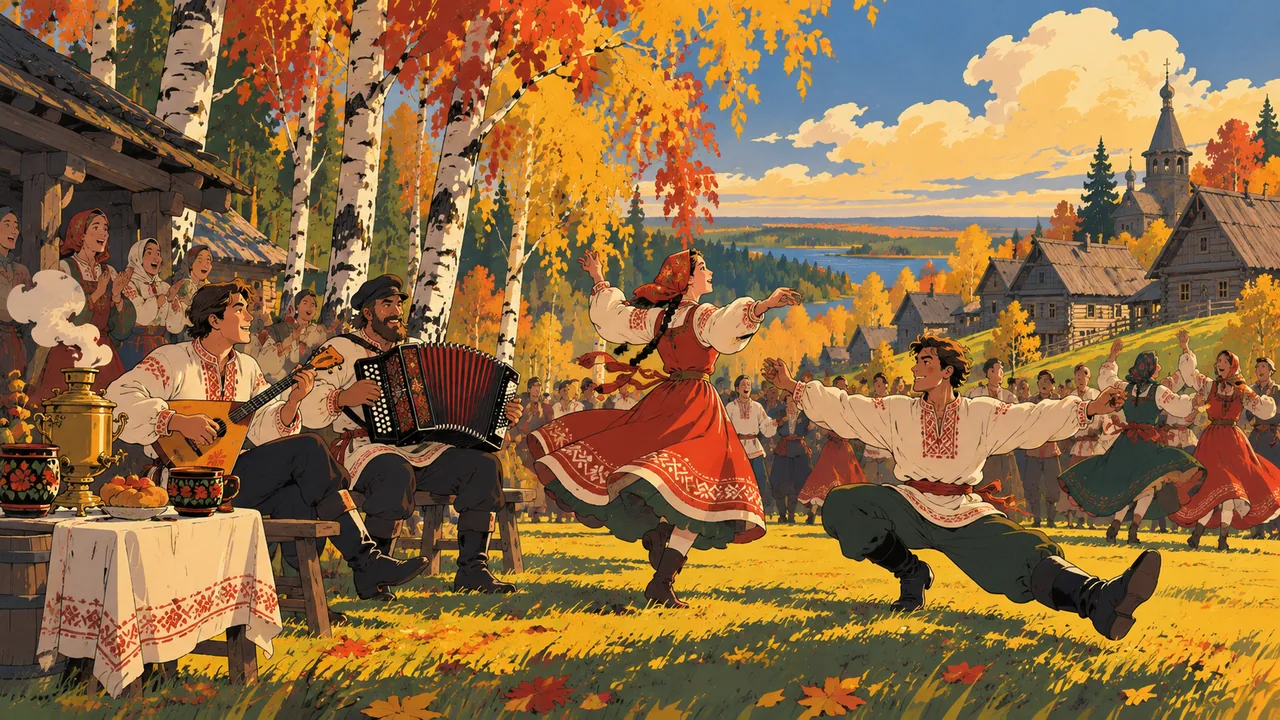
Balalaika and accordion getting faster and faster, clapping, stomping and squat-kicking: one song becomes a village party.
- Era
- Traditional–present
- Origin
- Russia
- Tempo
- 70–170 BPM
- Core instruments
- balalaika · bayan accordion · tambourine
AI prompt
Russian folk song, starts at 72 BPM and accelerates to 168 BPM, fast balalaika tremolo, domra and bayan button accordion, tambourine, wooden spoons, hand claps and stomps, bright chest-voice male and female unison singing in Russian, Opa shouts, festive village dance
267 charactersWrite Russian folk + balalaika + accordion, then add accelerating tempo for the ever-faster effect.
Rhythm
Duple dance groove with a refrain that keeps speeding up, often with sudden stops and shouts.
Drums
Tambourine, wooden spoons, claps and stomps.
Bass
Contrabass balalaika or the accordion's left-hand bass.
Synths / arrangement
Fast balalaika tremolo, domra, bayan accordion.
Vocals
Bright chest-voice unison, call-and-response between men and women, with shouts of Opa! and Hey!
A slow lyrical verse ends, the balalaika suddenly speeds up, and the whole room claps faster and faster.
- Period
- An old tradition; collected and arranged from the 19th century
- Regions & spread
- Russia
Russian folk song accompanies the seasons, weddings and work, often sung in a chest-register "white voice". The balalaika (a triangular three-string lute), domra, gusli and bayan (button accordion) are signature instruments, and Cossack squat dances and shouts of "Opa!" give it energy. In "Kalinka" (1860) the refrain gets faster each time it is sung, and "Korobeiniki" became world-famous as the Tetris theme. Soviet-era folk orchestras took these melodies onto big stages.
Social context
Village festivals and work needed music to sing and dance together; folk song is a community's memory.
Technology
The spread of the bayan and the folk-orchestra format took folk song from villages to stages and records.
Cultural psychology (interpretation)
Creative interpretation: The accelerating tempo makes you clap without thinking; the melody holds sorrow and big-hearted joy at once.
卡林卡 Kalinka
伊万·拉里奥诺夫 Ivan Larionov / SongHear a refrain that gets faster each time, and the balalaika tremolo.
货郎 Korobeiniki
俄罗斯民歌 Russian folk song / SongCompare the folk original of the melody everyone knows from Tetris.
Village festivals, tavern scenes and playful chase sequences
An ever-accelerating tempo naturally builds comedy and climaxes.
- What is Russian Folk?
- Russian Folk is a folk song · Russian. Balalaika and accordion getting faster and faster, clapping, stomping and squat-kicking: one song becomes a village party. Period: An old tradition; collected and arranged from the 19th century. Regions: Russia. A slow lyrical verse ends, the balalaika suddenly speeds up, and the whole room claps faster and faster.
- How do I write a Suno prompt for Russian Folk?
- Copy this full prompt:
Russian folk song, starts at 72 BPM and accelerates to 168 BPM, fast balalaika tremolo, domra and bayan button accordion, tambourine, wooden spoons, hand claps and stomps, bright chest-voice male and female unison singing in Russian, Opa shouts, festive village dance. Write Russian folk + balalaika + accordion, then add accelerating tempo for the ever-faster effect. - What BPM and instruments does Russian Folk use?
- Accelerating from about 70 to 160+ BPM. Drums: Tambourine, wooden spoons, claps and stomps. Bass: Contrabass balalaika or the accordion's left-hand bass. Synths / arrangement: Fast balalaika tremolo, domra, bayan accordion. Vocals: Bright chest-voice unison, call-and-response between men and women, with shouts of Opa! and Hey!
- What Russian Folk music should I start with?
- Start with “卡林卡 Kalinka” by 伊万·拉里奥诺夫 Ivan Larionov; “货郎 Korobeiniki” by 俄罗斯民歌 Russian folk song. The Key works tab notes what to listen for in each.
- What styles are similar to Russian Folk?
- Balkan Brass Same branch; Samba Similar mood · Bright & sweet; Bluegrass Similar mood · Bright & sweet; Regional Mexican Similar mood · Bright & sweet
Sources are used to check history, categories and works. Cultural psychology, visual language, creator uses, and the instrument and mood tags in the overview are editorial interpretation and do not speak for a whole community or an artist’s sole intent. Tempo ranges are only a starting point; listen to AI examples and adjust.
- Wikipedia · Russian folk music ↗Works and cultural background; sound, imagery and creator uses are editorial analysis
- Wikipedia · Kalinka (1860 song) ↗Works and cultural background; sound, imagery and creator uses are editorial analysis