Hip-Hop / Rap
Music family and culture / rap as vocal expression
Gives a community, a person and a way of life a place to speak on their own beat.
- Era
- 1970s
- Origin
- The Bronx, New York
- Tempo
- 80–100 BPM
- Core instruments
- drum machine · samples · bass · rap
AI prompt
Hip-hop storytelling, 94 BPM, syncopated drum groove, warm bass line and a restrained keyboard motif, original English rap vocal with clear rhythmic phrasing and intentional pauses, a short call-and-response hook, grounded neighborhood perspective, keep space between lines
273 charactersThis is a narrative example. The hip-hop / rap tag doesn't specify the whole sound: go on to name the underlying direction, such as boom bap, trap or dance, and settle the language, viewpoint, flow and the balance of voice and melody.
Rhythm
A looping groove and flow interact; syncopation, breathing, pauses and rhymes decide how words enter the beat.
Drums
Breakbeats, sampled drums, drum machines, 808s and live drums all work; settle the specific sub-style first.
Bass
Anything from funk bass loops to deep electronic low end; the bass should support the narration and the body's centre of gravity.
Synths / arrangement
Record fragments, keys, horns, strings or synths can all be material; sampling isn't required for every work.
Vocals
Rap can narrate, shout, converse or blend with melody; timbre, language, rhyme and rhythmic placement matter more than simply speed.
Rap is vocal expression and hip-hop is a wider musical and cultural entry point; the same rap can sit on different underlying arrangements.
- Period
- A key starting point in 1970s Bronx, New York, later growing into a global culture and many musical directions
- Regions & spread
- African American, Latino and Afro-Caribbean communities of the Bronx, New York · Later, other US cities and local scenes worldwide
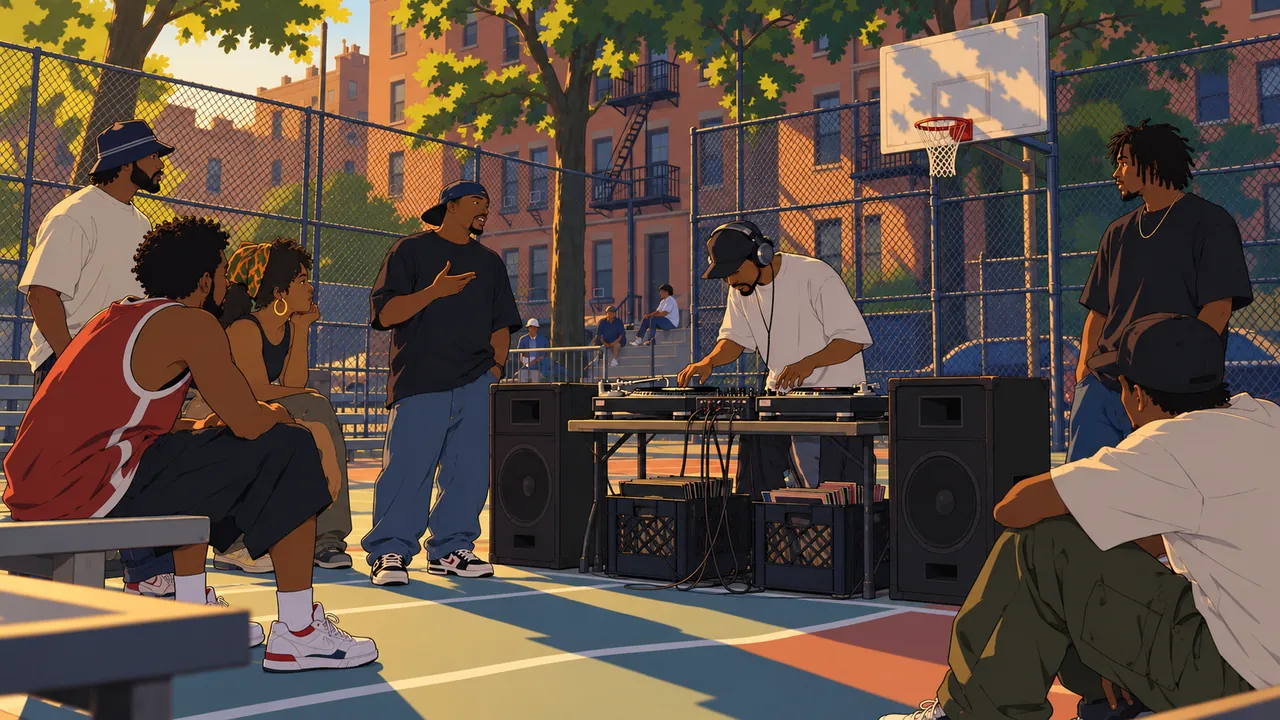
Block parties brought DJing, MCing, breaking and graffiti together. Hip-hop refers both to a cultural network and a music family; rap is vocal expression that rhythmically organises words, rhymes and sound, and can combine with other styles. Hip-hop instrumentals can exist without rap, so the two aren't fully interchangeable.
Social context
Facing poverty, exclusion and social pressure, young people in the Bronx built shared spaces through self-organised parties, performance and visual expression. The music could tell of life circumstances, and also serve dancing, humour, competition and call-and-response.
Technology
DJs used turntables to extend danceable breaks so MCs could talk with the crowd over a continuous rhythm; later samplers, drum machines, multitrack recording and online production expanded the sound, and different places developed different methods.
Cultural psychology (interpretation)
Creative interpretation: the beat gives the narrator a steady presence, and flow lets them decide how to approach others. Confidence, joy, anger and tenderness can all enter this language; one tough pose can't sum it up.
Rapper's Delight
The Sugarhill Gang / Song / early commercial recording as an entry pointListen to how the danceable bass and continuous groove support the rappers taking turns, and notice the conversational stance, humour and crowd feel. It's an important 1979 recording, not the single origin of hip-hop culture or all rap.
Bling-Bang-Bang-Born · MASHLE: MAGIC AND MUSCLES season 2
Creepy Nuts / Anime opening song / dance–rap fusionHear how R-Shitei's dense lines, rhythmic pauses and repeated hook combine with DJ Matsunaga's dance drive to create a character's confidence. The official notes link the character breaking through a magic world by physical strength to the artists' own experience; it's treated here as dance–rap fusion and not misfiled as trap.
Neighbourhood characters' self-narration, public performance and memories of daily life
Gives residents a culture they organise and express themselves; define the neighbourhood through viewpoint, language and a specific sub-style rather than just a "street" label.
Character manifestos, multi-voice relays and stances
On the same beat, different flows, breathing and responses show how characters differ, writing identity into action and tone.
Action comedy, character openings and rhythm levels
Short hooks and rhythmic pauses can organise action directly; decide the underlying groove first, then the balance of rap and melody.
- What is Hip-Hop / Rap?
- Hip-Hop / Rap is a music family and culture / rap as vocal expression. Gives a community, a person and a way of life a place to speak on their own beat. Period: A key starting point in 1970s Bronx, New York, later growing into a global culture and many musical directions. Regions: African American, Latino and Afro-Caribbean communities of the Bronx, New York, Later, other US cities and local scenes worldwide. Rap is vocal expression and hip-hop is a wider musical and cultural entry point; the same rap can sit on different underlying arrangements.
- How do I write a Suno prompt for Hip-Hop / Rap?
- Copy this full prompt:
Hip-hop storytelling, 94 BPM, syncopated drum groove, warm bass line and a restrained keyboard motif, original English rap vocal with clear rhythmic phrasing and intentional pauses, a short call-and-response hook, grounded neighborhood perspective, keep space between lines. This is a narrative example. The hip-hop / rap tag doesn't specify the whole sound: go on to name the underlying direction, such as boom bap, trap or dance, and settle the language, viewpoint, flow and the balance of voice and melody. - What BPM and instruments does Hip-Hop / Rap use?
- No single BPM; a narrative starting point here can try 80–100 BPM, while dance, trap and others need their own rhythm and tempo feel. Drums: Breakbeats, sampled drums, drum machines, 808s and live drums all work; settle the specific sub-style first. Bass: Anything from funk bass loops to deep electronic low end; the bass should support the narration and the body's centre of gravity. Synths / arrangement: Record fragments, keys, horns, strings or synths can all be material; sampling isn't required for every work. Vocals: Rap can narrate, shout, converse or blend with melody; timbre, language, rhyme and rhythmic placement matter more than simply speed.
- What Hip-Hop / Rap music should I start with?
- Start with “Rapper's Delight” by The Sugarhill Gang; “Bling-Bang-Bang-Born · MASHLE: MAGIC AND MUSCLES season 2” by Creepy Nuts. The Key works tab notes what to listen for in each.
- What styles are similar to Hip-Hop / Rap?
- Korean Hip-Hop Similar mood · Rebellious & bold; Chinese Hip-Hop Similar mood · Rebellious & bold; Boom Bap Same branch; Jungle Similar mood · Groove & energy
Sources are used to check history, categories and works. Cultural psychology, visual language, creator uses, and the instrument and mood tags in the overview are editorial interpretation and do not speak for a whole community or an artist’s sole intent. Tempo ranges are only a starting point; listen to AI examples and adjust.
- Smithsonian NMAAHC · Hip-Hop Origins ↗1970s New York, African American and Latino youth communities, DIY expression and later development across US regions; supports a broad cultural and musical entry point
- Smithsonian Folkways · Anthology of Hip-Hop and Rap ↗A diverse music history from the Bronx to the world, recordings such as Rapper's Delight, and cultural material
- Sugarhill Records · Rapper's Delight 官方视频 ↗The specific 1979 work and official listening link; not called the first rap song
- 《MASHLE》官方 · Music ↗Bling-Bang-Bang-Born as season 2 opening, R-Shitei's lyrics, DJ Matsunaga's music and the artists' notes on the character
- Creepy Nuts · Bling-Bang-Bang-Born 官方合作 MV ↗Listening link for the specific anime song; the dance–rap relationship is this page's sonic reading, not classified as trap simply because it's from anime