Sacred / Choral
Historical tradition and a reference entry point for scoring
First understand why people sang together, then decide why your world needs this solemnity.
- Era
- Medieval to Baroque
- Origin
- Western Europe
- Tempo
- Follows the phrase
- Core instruments
- choir · pipe organ · chant
AI prompt
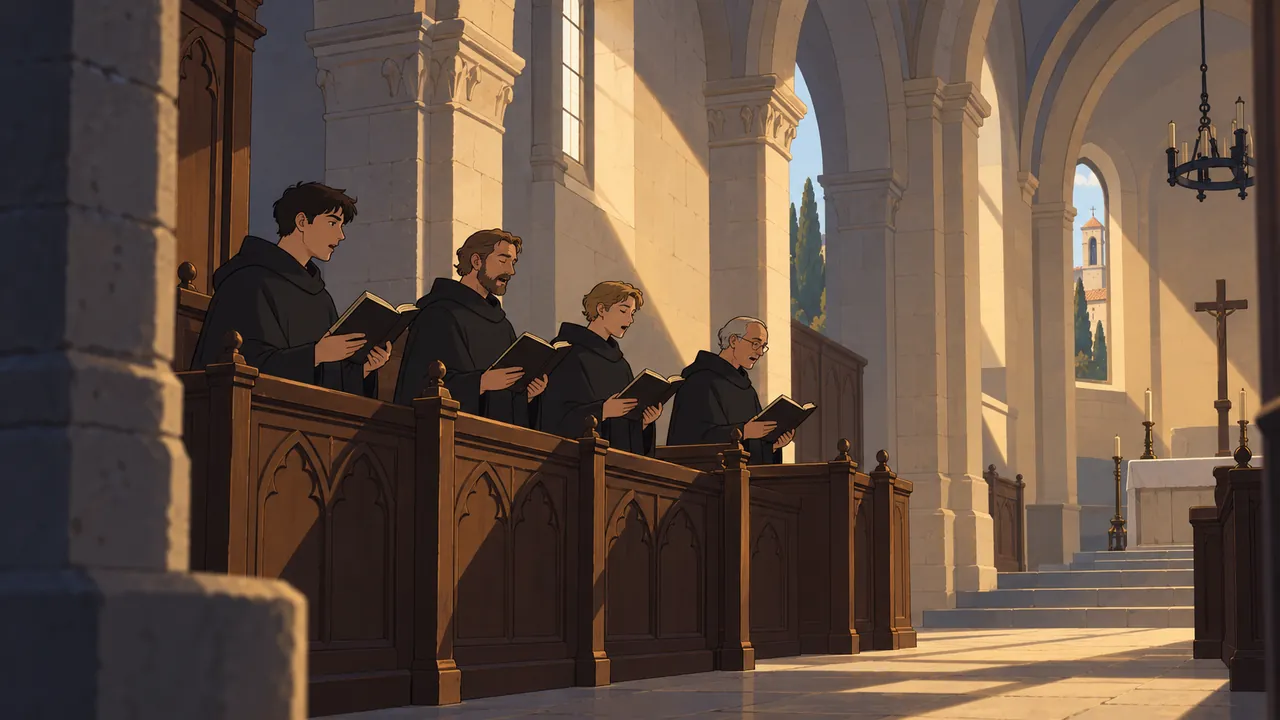
Original fictional ceremonial cue, contemplative unaccompanied chamber choir, four gently interweaving vocal lines on wordless vowels, each entry clearly separated, natural breathing and modest stone-room reverberation, restrained dynamics, warmth and uncertainty, no drum kit and no epic percussion, an intimate communal farewell rather than a trailer climax
359 charactersThis prompt chooses an original wordless multi-part choir and doesn't claim to generate Gregorian chant or reconstruct any real liturgy. For a monophonic chant direction, change to one shared melody breathing with the text; for an organ solo, write melody, inner voices and pedal bass separately, rather than piling all three requests together.
Rhythm
Monophonic chant: one shared melody; polyphonic choir: several melodic parts interweaving; organ works: one player organising melody, inner voices and bass. Don't blend the three into a generic "church sound".
Drums
This page's historical listening examples aren't driven by pop drums; if modern scoring adds drums, state their job in the scene separately.
Bass
Chant doesn't need a separate bass line; the lowest voice in polyphony takes part in the part-writing; organ pedals can give sustained or moving bass.
Synths / arrangement
The historical examples rely on voices or organ, with no synths needed. The organ is an instrument, not a synonym for choral voices; modern choir pads and organ samples are production material.
Vocals
Distinguish unison chant, multi-part choir and solo voice, and real scripture, wordless vowels and original fictional text. How voices enter, hand over and close decides the expression more than the length of the reverb tail.
Choose a compositional relationship first, then the space: one shared melody, several independent parts, or one player's instrumental prayer.
- Period
- Spans the medieval, Renaissance, Baroque and other periods; no single date of origin
- Regions & spread
- This page focuses on Western European Christian liturgical and church music traditions · Related sonic borrowing in modern film, TV, games and music
This page isn't an umbrella for all religious music worldwide, nor a fixed genre called "cathedral music". The transmission of Gregorian chant is tied to the Roman liturgy and medieval monasteries; Renaissance polyphonic choral music and Baroque organ works each have their own compositional and liturgical background. Borrowing these materials into modern scoring is a new narrative use, and doesn't make a game's choir real sacred music.
Social context
This historical music first served prayer, scripture, the liturgical calendar and community practice. Singing made the text an ongoing action within ritual, not just a way to create an ancient or eerie atmosphere. The uses in different regions, eras and church traditions need to be understood separately.
Technology
Chant was passed on orally and through notation; professional vocal training, organising multiple parts and organ playing expanded its expression. Today recording, sampling and artificial reverb can simulate large spaces, but spatial effects can't replace the design of melody, parts or text.
Cultural psychology (interpretation)
Creative interpretation: breathing together can merge the individual into a longer-lasting order, while a solo voice can turn the same space into one person's plea. Modern worldbuilding can use this distinction to design community and character, without assuming solemn means dark.
Salve Regina · Solesmes 1930
Chœur des Moines de l’Abbaye Saint-Pierre de Solesmes / Dom Joseph Gajard / Gregorian chant track / official release listeningFirst hear how the shared melody moves with the words and breath, without looking for pop-song drums or chord loops. It's chant from a specific liturgical tradition; the work's name, the historical recording year and the platform's reissue date are different pieces of information.
Sicut cervus desiderat
Giovanni Pierluigi da Palestrina / Westminster Cathedral Choir / James O’Donnell / Four-part sacred motet / record label's work and listening pageCompare with the previous monophonic chant: hear how the parts enter one after another and form relationships between long notes and lines that keep moving. Interweaving parts can build continuity on their own without constantly increasing volume; the page refers to the Westminster Cathedral Choir recording.
Ich ruf zu dir, Herr Jesu Christ, BWV 639
Johann Sebastian Bach / Leo van Doeselaar / Netherlands Bach Society / Organ chorale prelude / performing organisation's official videoHear how the upper melody, inner voices and pedal bass each work. It's an organ work based on a sacred song, with no singers in the recording; tenderness, hesitation and pleading can also happen in a vast space, so don't use the organ only for oppression or monster entrances.
Community rituals, farewells and places of refuge
First be clear who holds the ritual, to whom it's addressed and what changes; then choose unison, polyphony or a solo instrument. A shared melody can show community, and independent parts let one belief keep many voices.
A character making a private plea before a vast order
Keep a small vocal group or one instrument so the building's space and the character's fragility coexist; don't automatically use a huge choir just because the scene is in a sanctuary.
Solemnity gradually turning to uncertainty
Establish an understandable order first, then change distance, intervals or how parts enter. When modern scoring borrows religious timbres, make clear it's fictional storytelling; having choir and reverb doesn't mean a real chant tradition is being used.
- What is Sacred / Choral?
- Sacred / Choral is a historical tradition and a reference entry point for scoring. First understand why people sang together, then decide why your world needs this solemnity. Period: Spans the medieval, Renaissance, Baroque and other periods; no single date of origin. Regions: This page focuses on Western European Christian liturgical and church music traditions, Related sonic borrowing in modern film, TV, games and music. Choose a compositional relationship first, then the space: one shared melody, several independent parts, or one player's instrumental prayer.
- How do I write a Suno prompt for Sacred / Choral?
- Copy this full prompt:
Original fictional ceremonial cue, contemplative unaccompanied chamber choir, four gently interweaving vocal lines on wordless vowels, each entry clearly separated, natural breathing and modest stone-room reverberation, restrained dynamics, warmth and uncertainty, no drum kit and no epic percussion, an intimate communal farewell rather than a trailer climax. This prompt chooses an original wordless multi-part choir and doesn't claim to generate Gregorian chant or reconstruct any real liturgy. For a monophonic chant direction, change to one shared melody breathing with the text; for an organ solo, write melody, inner voices and pedal bass separately, rather than piling all three requests together. - What BPM and instruments does Sacred / Choral use?
- No single BPM; chant often follows the breath of the text and phrase, while polyphonic choral and instrumental works each have their own rhythmic structure. Drums: This page's historical listening examples aren't driven by pop drums; if modern scoring adds drums, state their job in the scene separately. Bass: Chant doesn't need a separate bass line; the lowest voice in polyphony takes part in the part-writing; organ pedals can give sustained or moving bass. Synths / arrangement: The historical examples rely on voices or organ, with no synths needed. The organ is an instrument, not a synonym for choral voices; modern choir pads and organ samples are production material. Vocals: Distinguish unison chant, multi-part choir and solo voice, and real scripture, wordless vowels and original fictional text. How voices enter, hand over and close decides the expression more than the length of the reverb tail.
- What Sacred / Choral music should I start with?
- Start with “Salve Regina · Solesmes 1930” by Chœur des Moines de l’Abbaye Saint-Pierre de Solesmes / Dom Joseph Gajard; “Sicut cervus desiderat” by Giovanni Pierluigi da Palestrina / Westminster Cathedral Choir / James O’Donnell; “Ich ruf zu dir, Herr Jesu Christ, BWV 639” by Johann Sebastian Bach / Leo van Doeselaar / Netherlands Bach Society. The Key works tab notes what to listen for in each.
- What styles are similar to Sacred / Choral?
- Baroque Same branch; Chinese Instrumental Similar mood · Calm & focused; Indian Classical Similar mood · Mystic & ritual; Impressionism (Debussy / Ravel) Same branch
Sources are used to check history, categories and works. Cultural psychology, visual language, creator uses, and the instrument and mood tags in the overview are editorial interpretation and do not speak for a whole community or an artist’s sole intent. Tempo ranges are only a starting point; listen to AI examples and adjust.
- Abbaye de Solesmes · Gregorian Chant History ↗Gregorian chant's identity in Roman Catholic liturgy, oral transmission and medieval notation background
- Editions de Solesmes · Solesmes 1930 ↗The specific chant recording, ensemble and Salve Regina track; supplements the source of the official Spotify listening
- Hyperion Records · Sicut cervus desiderat ↗Palestrina's four-part motet, its text source, recording credits and the timing of the parts; modern creative uses are this page's separate interpretation
- Netherlands Bach Society · BWV 639 ↗The organ work's identity, the relationship between chorale preludes and sacred songs, the official performance and performer credits